1 July 2020
Program
First session is on zoom.
Register here: https://zoom.us/meeting/register/tJwvcuGoqjsrEtD2Azl1DQRbn8QOdPHVusMQ (Password is 361695)
10-12noon LGBTIQ+ Workshop – Amelia Arnold, Suicide Prevention Training Project Officer, Thorne Harbour Health
Rest of teaching is on Microsoft Teams
12-1215hr, lunch, teams log in
1215-1245hr – ECG/image/gas of the week
1245-1315hr – Sarah B – Tropical Medicine with a Top End Focus
1315-1345hr – Maria – Managing vulnerable patients in the ED
Please note that Webex is no longer being used as we have moved to Microsoft Teams
+61 2 8320 9200 Australia, Sydney (Toll)
Conference ID: 714 090 561#
Key Learning Points
LGBTIQ+ Workshop
Within the LGBTIQ+ communities, we as health care providers generally have more difficulty with the transgender and intersex communities. Why? Largely because this is something that we have been taught/learn.
Amelia from Thorne Harbour Health showed this video as part of her workshop. There are a number of other videos from the Trans 101 group.
There are some excellent resources out there to help us in the ED
Have you signed up to EMRAP yet? If not, do it. I have no conflict of interest, only to suggest my experience is that it is an excellent educational resource. There is a great episode from August 2019 describing some of the ED specific issues when carding for the LGBTIQ+ communities.
https://www.emrap.org/episode/emrap2019august/equalaccessfor
If you want to read a bit more about caring for patients in the ED click on the below images.

Transgender Care Guide

Working therapeutically with LGBTI Clients: a practice wisdom resource
ECG of the Week
A 42 year old male presents with sudden onset of palpitations. HR 150, BP 125/80, GCS 15, RR 12, SpO2 99% RA.
This ECG shows a narrow complex regular tachycardia at 150bpm. There is a right axis deviation and possibly retrograde p-waves best seen in V1.
My approach to all arrhythmias is to ask myself three questions.
Is it fast or slow?
Is it narrow or wide?
Is it regular or irregular?
By doing this there are only a handful of differential diagnoses.
So for this case the rhythm is fast, narrow and regular and therefore is one of: sinus tachycardia, Atrial Flutter, SVT (AVNRT or AVRT), junctional tachycardia or atrial tachycardia
Let’s say the rhythm was fast, narrow and irregular. The differentials are now atrial fibrillation, multifocal tachycardia or atrial flutter with a variable block.
You can do the same for all variations based on those three questions.
So back to this ECG. To help differentiate between the above possibilities
Look for P waves. These are best seen in V1. Are the P waves hidden in the previous T wave?
Look for flutter waves
Are there other signs of digoxin toxicity? (Commonest cause of junctional tachycardia)
What is the rate doing on the monitor? Atrial flutter is usually very fixed with minimal variation. Sinus tachycardia still goes up and down with pain and exertion.
It can be hard to tell and often you end up with “It is most likely x but could also be y or z”. Remember that valsalva or adenosine can slow down the rhythm enough to make the diagnosis. I.e. the p waves or flutter waves become apparent.
Image of the Week
You are the ED reg at 2am in ‘The Bush’ (rural emergency department)
28y/o male p/w a hand injury, unclear mechanism. Patient reported a screwdriver “fell” from a shelf causing the injury.
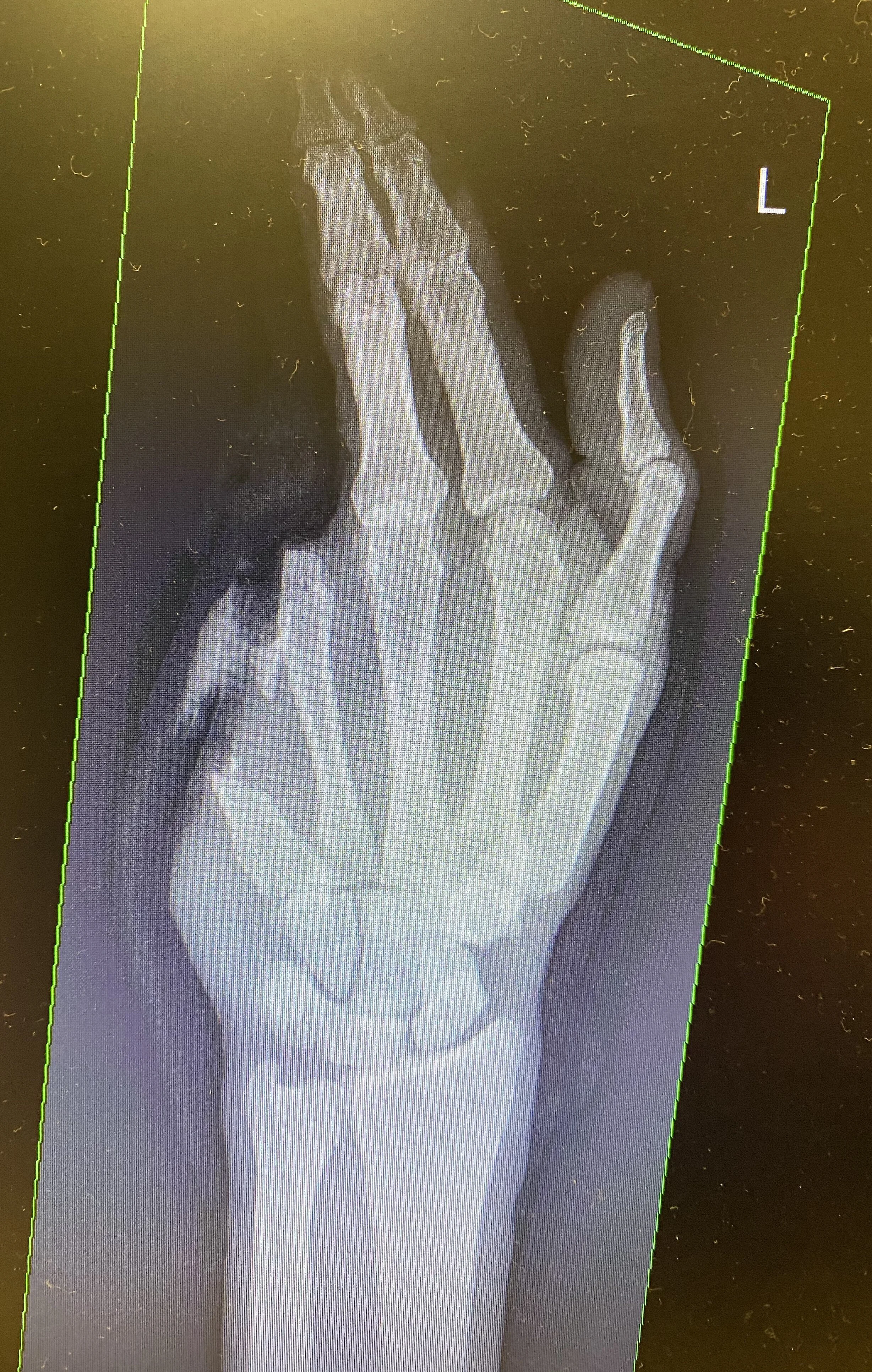
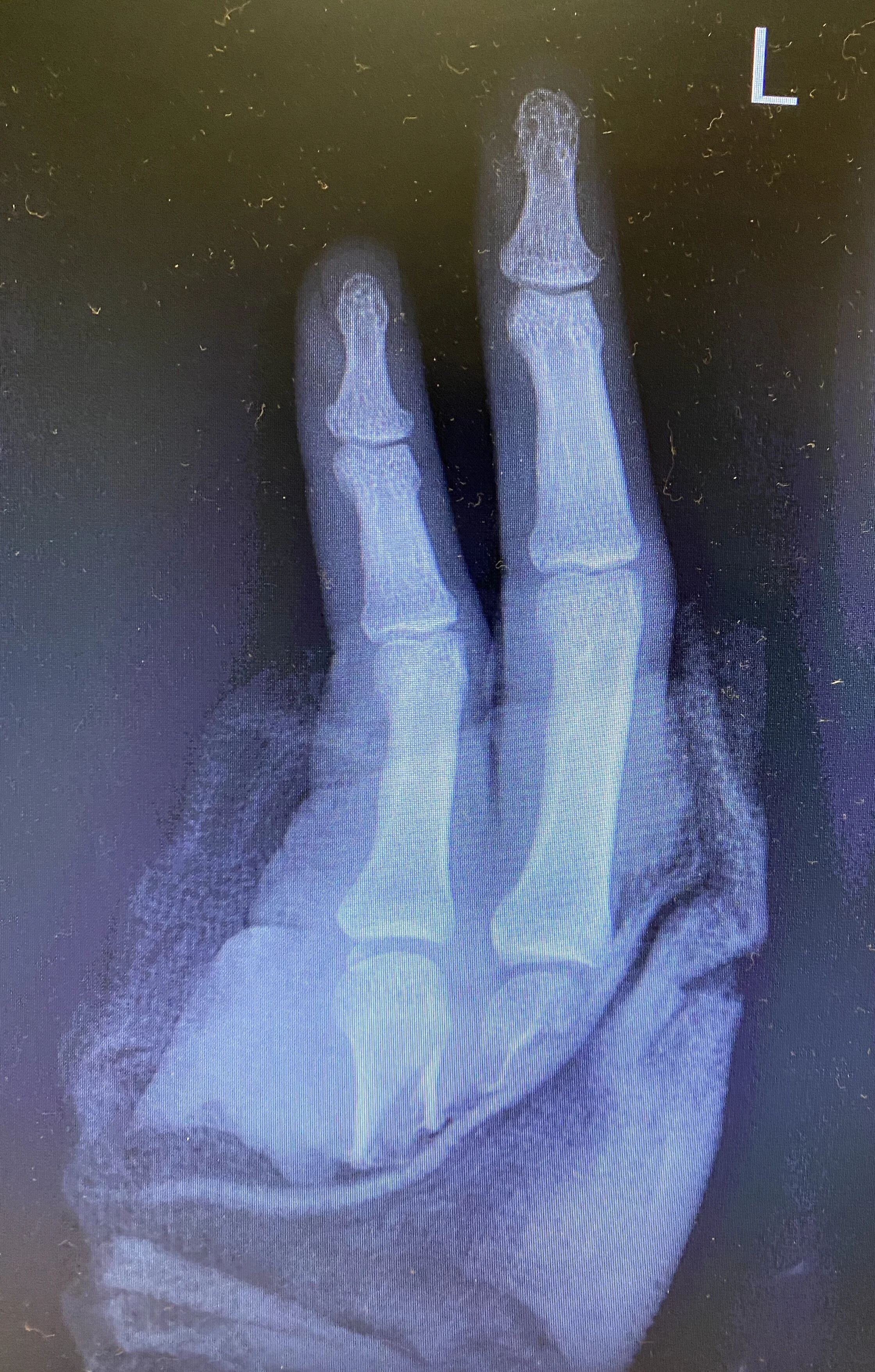
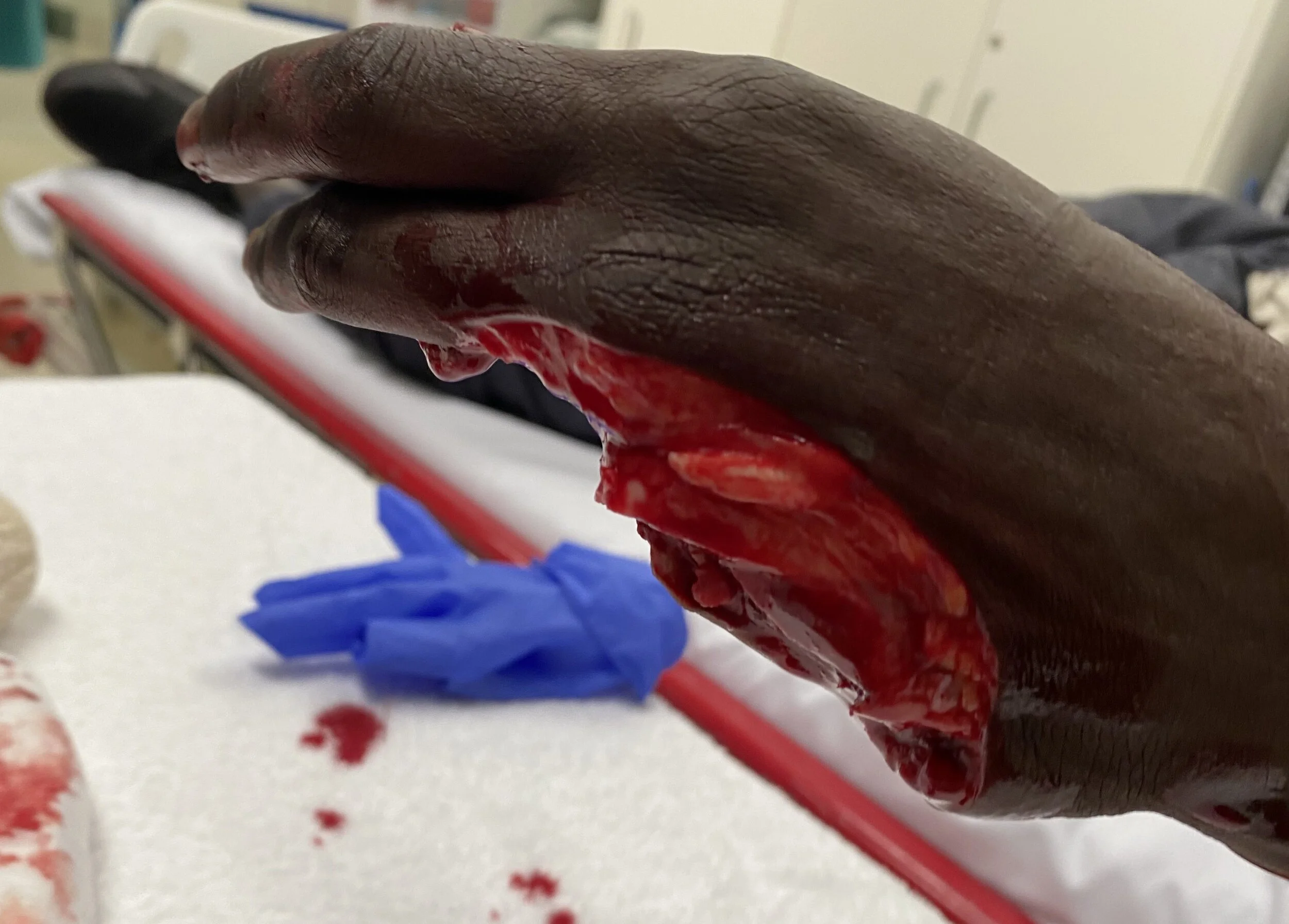
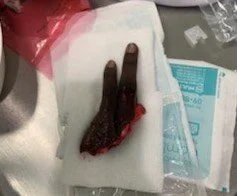
Image interpretation
1. Amputation
Ring & little fingers
Ulnar portion of the hand, from the webspace of 3rd/4th digits, to the mid-hypothenar eminence
2. Open fracture
Active haemorrhage
Intact 4th & 5th fingers
These injuries are not consistent with the stated mechanism
Xray Interpretation:
Amputation
Fracture through the 4th metacarpal head
Comminuted fracture of 5th metacarpal shaft, displaced fragment
No appreciable injuries to 4th & 5th digit phalanges
No other appreciable fractures
A common theme discussed is terminology. We need to use appropriate language when describing injuries and xrays. Perhaps we can discuss this another day but the difference between a partial and a complete amputation. What is a laceration? What is an incision?
Tropical Medicine
Melioidosis (Burholderia pseudomallei) is endemic in the wet season of northern Australia (November - April)
It can cause pneumonia, deep abdominal abscesses and visceral (liver and spleen) abscesses, skin effects, bacteraemia and cerebral infection (rare)
During these months empiric treatment for severe sepsis includes meropenem and vancomycin. Think about the returned traveller from Darwin to Melbourne also during these months.
Strongyloides is a parasitic infection that can occur in northern Australia. You can ingest the eggs by drinking contaminated water - yuck. Symptoms include itch, cough or abdominal pain depending on the location of the parasite.
It is usually diagnosed on stool culture.
Severe infections can occur in the immunocompromised.
Treatment is with albendazole
Interesting blood gas
75 yo male
Presented to the ED with 2/52 of non-specific gastrointestinal illness with abdominal cramps, vomiting, diarrhoea and poor oral intake.
PMHx: Nephrectomy for RCC, NASH, Severe aortic stenosis, T2DM
Meds: Metformin, Linagliptin, Perindopril, Statin
SHx: Independent
HR 80, BP 130/80, SpO2 98% RA, RR 32
Dry mucous membranes, poor tissue turgor
Look at the gas and biochemistry from 23/6/20 when the patient arrived.
Ketones were 6
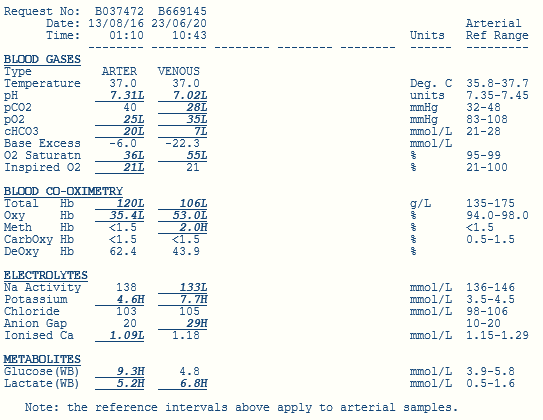
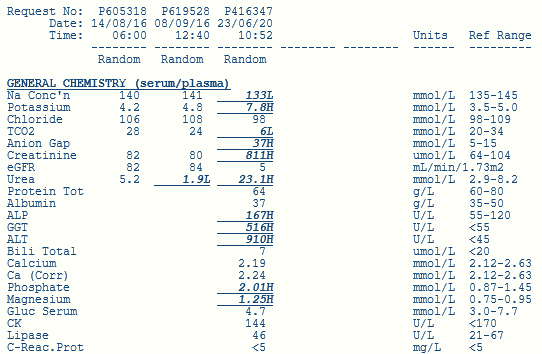
This gas shows a profound metabolic acidosis. It is a venous gas so looking for expected CO2 is not accurate. However, if you were to assume it was arterial then 1.5 x 7 + 8 = 18. The actual pCO2 is 28 so there would also be a respiratory acidosis.
Traditional Method
AG = 133 - 105 - 7 = 21
Ratio = (21-12)/(24-7) = 0.6
Therefore there is a HAGMA + NAGMA. Potential causes of the HAGMA include lactate, ketones and renal. Toxins unlikely given the stem. Potential causes of the NAGMA are acid loss from diarrhoea and renal tubular acidosis.
Fencl-Stewart
SID = 133 + 8 - 105 = 35 therefore chloride effect on base excess is - 7. There is a hyperchloraemic acidosis likely from
Lactate effect - 6
Albumin effect + 1
Sum effect is -12. Actual measure base excess is -22 therefore there is an unexplained metabolic acidosis accounting for -10 base excess. This is likely ketones and possible an unknown affect of renal failure.
Other information from this gas
Venous gas so oxygenation can’t be assessed
Severe hyperkalaemia requiring urgent treatment. Expected potassium for pH is 7.
Remember to look back at the blood gas interpretation posts in the blog menu above if you need a refresher.