
Fencl-Stewart Acid Base: A really simple approach
Alex Handrinos
Peer review: Mark Rugless
Background
The Fencl-Stewart method of blood gas interpretation can identify the metabolic abnormalities seen in a blood gas. It can be used as an alternative to the traditional approach of the anion-gap and delta ratio. I suggest reading this post in addition to the traditional approach to gas interpretation here.
Here is a step-wise approach to using this method noting that in the literature there are many different ways of doing so. This post does not discuss the physiology of why this approach works. If interested, discuss this with Mark.
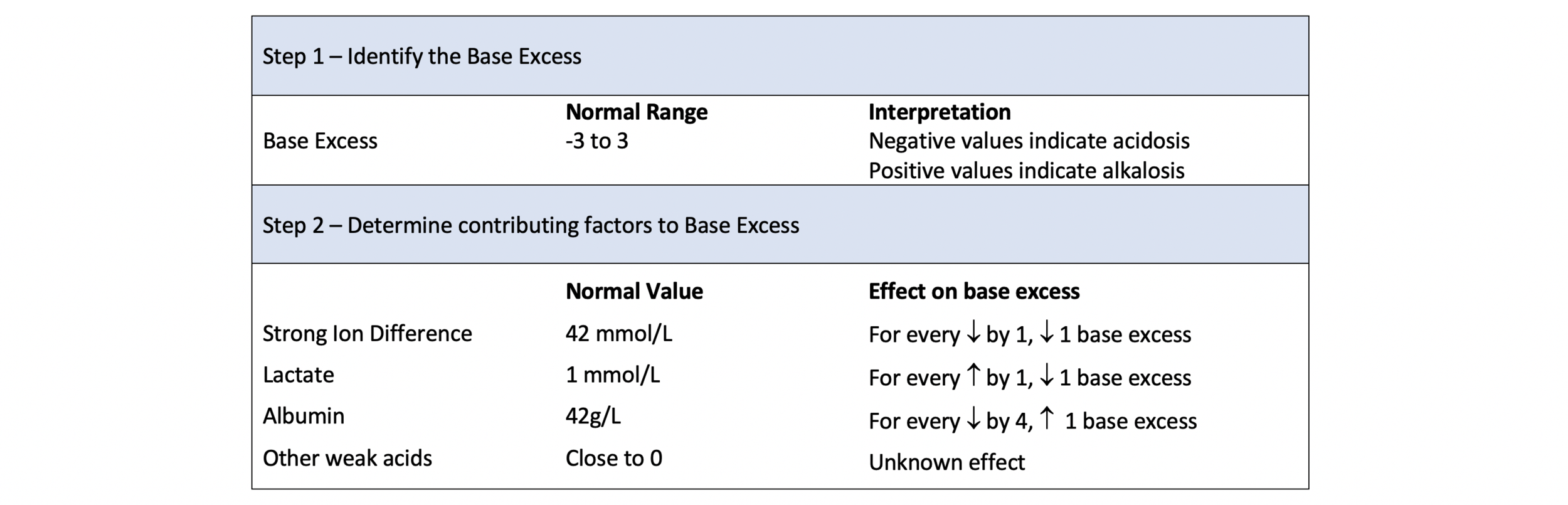
Step 1 - Look first at the base excess
Base excess is a single variable used to quantify the metabolic (non-respiratory) component of a patient’s acid-base status. It is defined as the amount of strong acid (in mmol/L) that needs to be added in vitro to 1 liter of fully oxygenated blood in order to return the sample to standard (normal) conditions (pH 7.40, pCO2 40 mmHg and temperature 37 °C.) If blood already has a pH of 7.40, a pCO2 of 40 mmHg and a temperature of 37 °C, then base excess is by definition 0 mmol/L.
Normal base excess ranges between -3 to 3 mmol/L. Increasingly negative values indicate a metabolic acidosis and positive values indicate a metabolic alkalosis. A base excess of -10 suggests a mild metabolic acidosis where a base excess of -30 suggests a more severe metabolic acidosis.

If the base excess is outside the normal range then the Fencl-Stewart method can help find the “attributing” factors. In essence, this method aims to explain the difference between the measured base excess and the normal range thereby identifying the metabolic abnormalities present. For example, if the base excess is -10mmol/L and assuming 0mmol/L is the normal value we need to try and “account” for these 10 mmol. The next steps show how to find the attributing factors which includes the effects of:
Chloride (using the strong ion difference)
Lactate
Albumin
Other weak acids
Step 2 - Calculate the Strong Ion Difference
Simplified SID = Na + K - Cl
SID = 42
This should equal 42 based on the normal physiological values for these ions.
As the strong ion difference is decreased the blood becomes more acidic. A decrease in the SID suggests a relative increase in chloride where chloride is considered an acid and is a strong ion. Therefore for every 1 derangement of chloride, the base excess should change by 1 in the opposite direction.
SID < 42 There is a hyperchloraemic metabolic acidosis
SID > 42 There is a hypochloraemic metabolic alkalosis
To compare the interpretation with a traditional approach, this theory assumes that most of the causes of a NAGMA are due to hyperchloraemia and most causes of a metabolic alkalosis are due to hypochloraemia.
Let’s look at an example where the the SID is calculated as 32. Ie. there is relative increase of 10 chloride ions.
We can use the above diagram to work backwards and try to explain the change in base excess. The red arrows indicate the expected base excess if the chloride problem (in this case a chloride excess) was taken out of the equation.
If the base excess is -10 then this will all be attributed to the effect of 10 ‘extra’ chloride ions.

If the base excess is -15, and the SID remains 32, then there is another acidosis of -5 still to be accounted for.

Or, if the base excess is -5, and the SID remains 32, then there must also be an alkalosis present.

Step 3 - Lactate
Lactate is another acid considered a strong ion. Similar to chloride, for every 1 increase in lactate beyond the normal range (1 mmol\L), the base excess should decrease by 1. (ie. become more negative)
For example, if the lactate was 4.0mmol/L then the base excess should decrease by 3. An alternative way of looking at this is if the base excess was -3 and all other values were considered normal, then this entire change in base excess could be attributed to the lactate.
Step 4 - Albumin
Albumin is considered a weak acid. Unlike lactate, the problem is not usually an excess of acid in the body, but rather decreasing levels of acid as we lose albumin. Therefore low albumin causes a metabolic alkalosis. You never really get a hyperalbuminaemia. Given it is a weak acid the ratio is not 1:1 with base excess as was the case for chloride and lactate.
Normal albumin is coincidentally also 42(g\L). For every four albumin below 42, the base excess should increase by 1. Another way of saying this is the albumin effect is 0.25 x [42-albumin].
For example, if the albumin is measured to be 26 g/L then the base excess should increase by 4. Further, if the base excess was +4 and all other values were considered normal then the change in base excess from 0mmol/L could be entirely attributed to the albumin.
Step 5 - Other acids
Once the effect of chloride, lactate and albumin have been applied there may still be an unexplained effect on the base excess. There are two methods of working this out and people tend to have a preference one way or the other. Both work. The first is a visual, cumulative approach, as shown in the diagrams throughout this piece with the red arrows. The other method is a summative approach where you can calculate the sum of the effects of each variable on the base excess. You can then look at the difference between this calculation and the measured base excess to determined if there is another unexplained effect occurring. See the worked examples below where both methods are used. I personally prefer the summative approach.
Any unexplained effect is likely going to be attributed to other unmeasured weak acids. Albumin is the most important weak acid which has already been accounted for as above. Other weak acids include ketoacids, toxic alcohols, salicylates, sulphurs, phosphate and a large range of others acids and proteins. In health, the effect of these are all minimal.
Summary
Look at the base excess. Increasingly negative values indicate a metabolic acidosis
Calculate the Strong Ion Difference. SID = Na + K - Cl. This should equal 42. For every 1 derangement of chloride, the base excess should change by 1 in the opposite direction
Look at the lactate. For every 1 increase in lactate beyond the normal range (1 mmol\L), the base excess should decrease by 1.
Look at the albumin. For every 4 albumin below 42, the base excess should increase by 1
Attribute any other effects to unmeasured weak acids
Example 1
Let’s consider the same example we used in the bicarbonate based traditional approach. On this occasion, we will just focus on the metabolic aspect.
A 40 yo male multi-trauma patient attends the hospital after a high speed MVA. The ambulance have given him several litres of crystalloid en route to the hospital. He has obvious chest injuries.
Vitals
HR 110, BP 95/75, RR 34, SpO2 92% on 0.4 FIO2, GCS 7
Consider the following arterial blood gas:
FiO2. 0.4
pH 7.09
pO2 76 mmHg
pCO2 65mmHg
HCO3- 14 mol/L
BE -8
O2 Sats 92%
Na+ 135 mmol/L
K+ 4.2 mmol/L
Cl- 103 mmol/L
Glucose 6.2 mmol/L
Lactate 4.1mmol/L
Hb 82g/L
Step 1
The base excess is -8 indicating a metabolic acidosis
Step 2
The strong ion difference is 135 + 4.2 - 103 = 36
Therefore there is a chloride excess of 6. This leaves us with a BE of -2. See red arrow for a visual approach.
Step 3
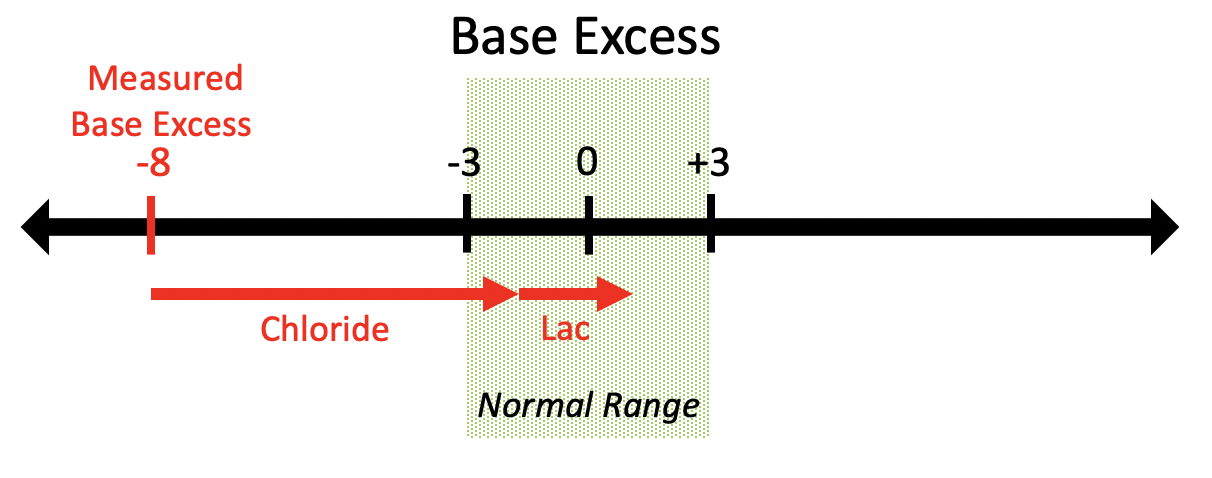
There is an extra 3 lactate above normal. So the BE becomes +1. See the second red arrow.
Step 4
We don’t know the albumin, assuming it is normal the BE remains +1
Step 5
With the BE within the normal range, we can assume there is minimal effect of any other weak acids
Alternative summative approach:
Chloride effect = -6
Lactate effect = -3
Albumin effect = 0
Sum effect of the above = (-6) + (-3) + 0 = -9
Given the measured base excess is -8 (i.e. +/- 2 of our sum effect) we can assume there is minimal effect of any other weak acids
Summary
In summary this patient has two processes contributing to the metabolic acidosis - hyperchloraemia presumably from the crystalloid administration and lactate presumable from shock.
Example 2
This is a more complex example in a patient who presented with weakness.
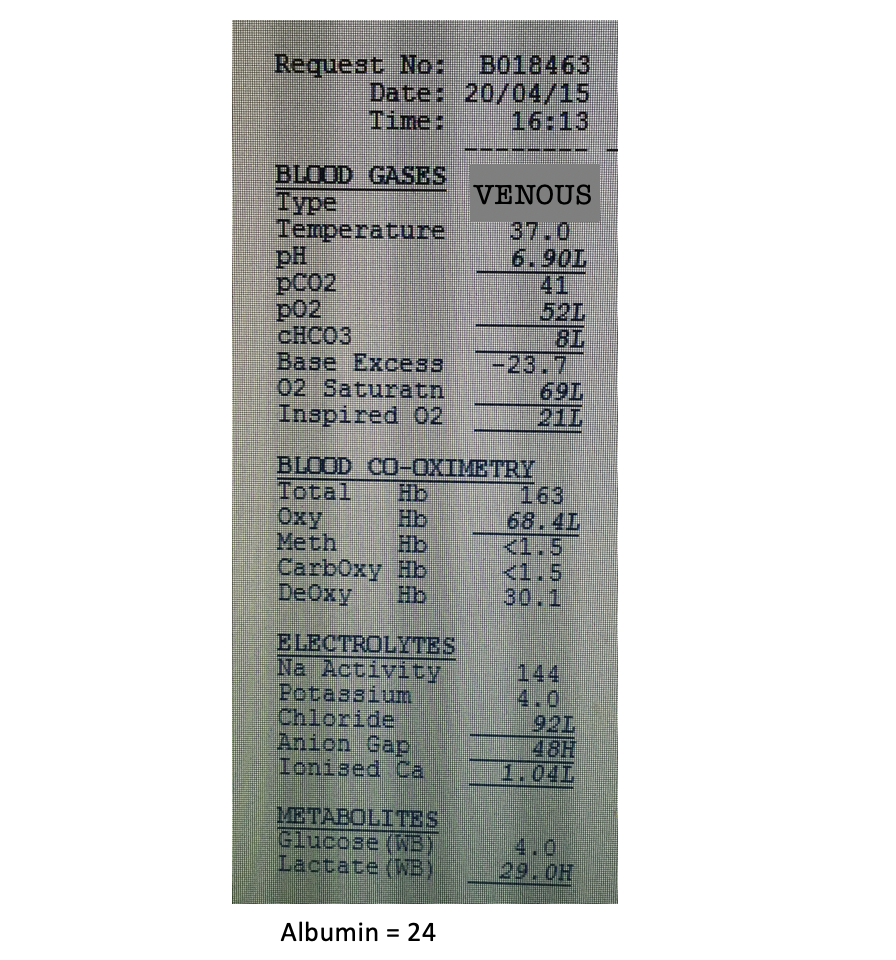
Step 1: In this example the BE is -24 indicating a severe metabolic acidosis.
Step 2: The SID is 144+4-92 = 56. Therefore there is a hypochloraemic metabolic alkalosis. There is a chloride deficit of 14 and therefore the BE should increase by 14. Therefore this does not account for the measured -24 in BE and the red arrow below goes the other way. I.e If there wasn’t this hypochloraemic alkalosis affecting this gas the BE would actually be -38!
Step 3: The lactate is 29! There is an excess of 28 lactate ions and therefore the BE should decrease by 28 and the red arrow moves back towards the normal range
Step 4: The albumin is 24. The effect of albumin is therefore 0.25 x [42-24] = 4.25. Rounding this up to 4, the BE should increase by 4.
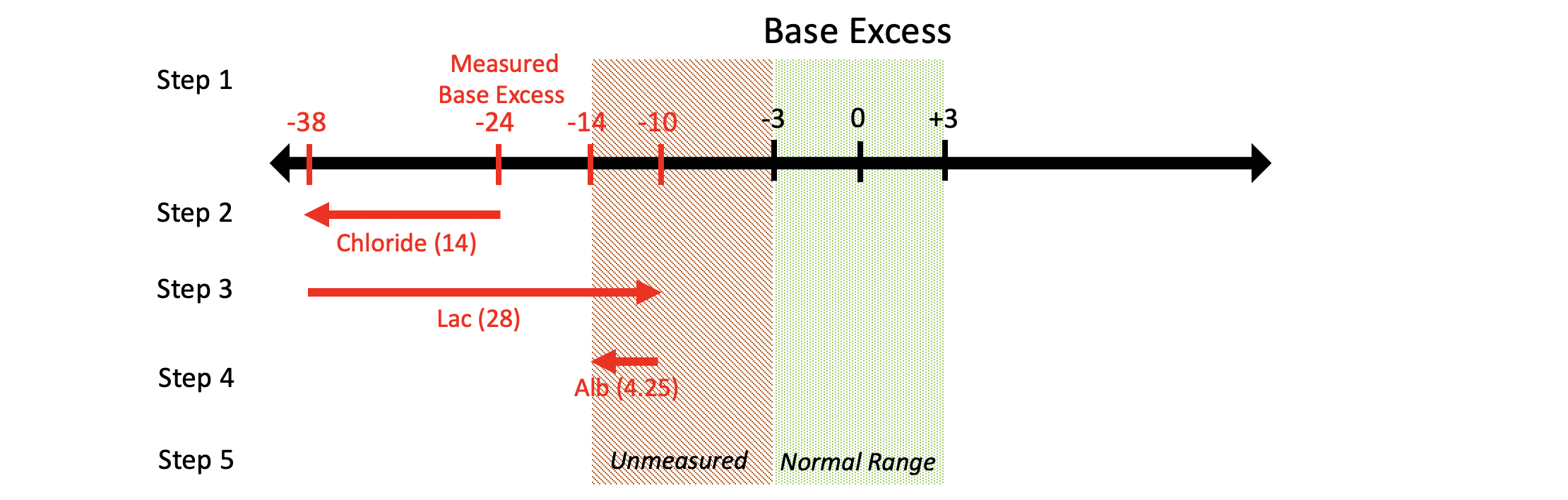
Step 5: Overall, adding all of the above we are still left with -14 unexplained component of the base excess (see both visual and summative approaches below)
Step 5 - Visual approach: Pictorial interpretation of the example 2 where the individual processes try to account for the measured base excess.
Step 5 - using a Summative approach:
Measure base excess = -24
Chloride effect = +14
Lactate effect = -28
Albumin effect = +4
Sum effect = 14 + (-28) + 4 = -10
The actual measured base excess is -24 leaving a difference of -14 not accounted for
Summary
There are at least four acid-base processes going on.
There is a moderate to severe hypochloraemic metabolic alkalosis
There is a severe lactic metabolic acidosis
There is a mild alkalosis due to albumin loss
There is another severe metabolic acidosis likely explained by unmeasured ions - ? ketoacids, ? toxic alcohols etc