On Shift in the ED
ED Team Based Care is intended to improve the quality of care through having clear transparent lines of reporting and supervision, teamwork, efficient communication and shared problem solving. Medical teams are personnel based (not zoned) with junior staff being supervised by senior staff from the same team.
All medical staff members are allocated to a team
Team allocations are rostered and should be written on the whiteboard at the start of the AM shift - grab a phone and write your contact number up.
Junior doctors should identify themselves to their team leaders as they commence their shifts. If in doubt who is who, ask the AO.
Wherever possible, consultation should be with the senior doctors on that team.
Early consultation with the team leader should be sought by all doctors to plan patient disposition - within 20 minutes of initial assessment
Team Structure - Weekday
Red Team
AO Consultant, Resus Reg, other JMS
Cover resus and acute cubicles
First responders for External Code Blues (see below)
HUB Team
Hub Consultant, resident/intern +/- registrar (see below)
Covers the Mental Health and AOD Hub
Yellow Team
Consultant, Code Grey Reg, other JMS
Cover acute cubicles
First responder for Code Grey / BAR (see below)
Fast Track Team
Nurse Practitioner, Primary Contact Physio
Medical staffing as roster allows
Responsible for Fast Track (‘Clinic’)
Also responds to ED Trauma Calls
Blue Team
Consultant, ESS resident/intern +/- registrar
Covers Short Stay (ESS)
Rapid Assessment Team (RAT)
RAT Consultant, Nurse
Responsible for the rapid assessment and initial management of waiting room patients prior to their assessment by an acute team
* REGISTRAR ASSIST ROLE:
Weekday AM shifts may also feature a Registrar Assist role for the BLUE and HUB teams. This is an opportunity for Emergency Registrars to have exposure to and experience of observational medicine. This will be denoted on the roster. Registrars will spend the start of their day linked with the ESS or HUB team, then move to the Yellow team once their ESS/HUB experience is complete.
The expected role of the Blue/Yellow registrar would be to:
o Take handover of ESS beds 27-32 at AM handover
o Lead the ESS ward round for these patients (under directly observed supervision of the Blue consultant)
o Continue management of these 6 patients throughout the day to their final disposition (i.e., discharge home or admitted to ward)
o Following completion of the tasks from the ward round, the Blue registrar then takes on acute patients on the main floor and presents these patients to the Yellow consultant.
o The Blue registrar is NOT be responsible for any new patients transferred into ESS beds 27-32 through the day.
o The Blue registrar would hand over any ESS patients who remained in ESS at the end of their shift to the incoming PM Blue consultant.
The expected role of the HUB/Yellow registrar would be to:
o Take part in the HUB handover from night staff to AM staff.
o Shadow the HUB team ward round through the HUB
o Take part in the AM team huddle (DOAM/HUB team)
o Once they had completed ward round and huddle, they would re-join the main floor to take on acute patients, and present these patients to the Yellow consultant
On days where there are unplanned shortfalls in staffing (sick leave etc.), these roles would revert to the Yellow registrar roles.
Team Structure - Weekends and Nights
A weekend shift will consist of RED, BLUE and RAT/HUB Teams, with the remaining clinical responsibilities divided amongst team members at the discretion of the AO
Overnight there will usually be at least 6 medical staff
Senior and Junior ED Registrar - the senior registrar carries the AO phone and is responsible for overall departmental management
3 HMOs and an Intern - one resident will have primary responsibility for the HUB.
There is a Consultant on call every night - usually the evening shift AO.
If there are clinical concerns, an excessive workload, or other problems to be solved please do not hesitate in contacting the on-call
The Consultant on call can be contacted via switchboard. There is also a blue folder on the left hand side of Jenni’s desk containing all the contact details of the ED Consultants and the ED Registrars.
As a general rule the answer to “Should I ring the consultant?” is probably yes
Consider discussing the situation with the Nurse-In-Charge, they are very experienced and a good source of advice
Define the problem(s), and what you require assistance with - be explicit if you want the consultant to attend in person, and state this upfront
The Nightshift Standard Operating Procedure document can be viewed below - recommended reading prior to your first night
Handover
Concise accurate handovers are key in achieving high quality patient care. These occur at set times between shifts and are led by the incoming team leader (AO or overnight senior registrar)
Morning Handover - 0730, ED Handover Room. Attended by all night staff, morning consultants and registrars, ESS intern (other HMOs & interns get started on the floor)
Afternoon Handover - End of Shift ~1600-1700. Occurs one-on-one on the floor, all patients should be handed over to the incoming team leader
Night Handover - 2230, ED Handover Room. Handovers are split between the senior and junior night registrars. Night HMOs & interns are not required to attend handover and can get started on the floor
Patient Management and Flow
After consultation with your team leader, it may be that your patient requires an admission to either an in-patient unit or the Emergency Short Stay Unit (ESS). The videos below outline some key principles behind these referrals.
For in-patient admissions, the ED Admission template should be completed in the patient’s PAS notes - select this from the dropdown menu and complete each section. This acts as an interim admission note should a ward bed be available before admitting team review.
For Emergency Short Stay admissions, the ESS Admission template should be completed in the patient’s PAS notes - select this from the dropdown menu and complete each section.
On transfer to ESS, care of the patient is handed over to the ESS Consultant
Prior to transfer to ESS, all patients should have clear documentation of a working diagnosis and management plan documented, as well as a drug chart (including regular medications, appropriate analgesia etc.) completed. Don’t admit someone for analgesia without it charted!
All patients discharged from ESS should have an ESS Discharge Summary - select this template from the dropdown menu and complete
ED Admission Principles
Emergency Short Stay (ESS)
10 Golden Rules of ED Flow
I. All staff on every shift to be allocated to a team
II. Direct supervision of all team members by team leader
III. All patients to be discussed with team leader within 20 min of medical review
IV. Early bed requests including ESS
V. Hit ‘decision to admit’ button for ALL patients upon admission decision being made
VI. Time stamp all referrals by hitting ‘Consultation’ button in PAS
VII. Use Emergency Alert Dashboard to identify patients between 3 and 4 hours in ED
VIII. Use short stay as a decision-making unit as appropriate
IX. ALL ESS patients MUST have a clear plan for their admission including drug chart/fluid orders
X. Escalate referrals to relevant Consultant if difficulty contacting Unit Registrar
Codes (2222)
Code Blue
ED is responsible for attending all ‘out-patient’ code blues, as well as those occurring in the in-patient Mental Health Unit. This scope includes all non-clinical areas of the in-patient buildings, external areas such as car parks, external dialysis unit, 55 Victoria Parade, Healy/Daly Wings, private radiology and consulting areas. Very occasionally an ambulance may be required to extricate patients from some areas
Personnel - Resus registrar, resus nurse, SSA
Equipment: Code Blue bag, defibrillator, trolley - take a phone and assist by carrying a piece of kit.
Code Grey (Acute Behavioural Disturbance)
Please review these two key documents detailing expected practice in the event of a Code Grey and appropriate use of the Mental Health and Wellbeing Act (MHWA)
Code STEMI
Code STEMI operates 24 hours a day. Switchboard will facilitate a brief discussion with the interventional cardiologist on call prior to cath lab activation. This can occur prior to the patient’s arrival to ED following AV pre-notification
Code Stroke
Code Stroke operates 0800-1700 Monday to Friday for patients presenting with symptoms suggestive of stroke within 24 hours of onset. Outside of business hours, you must contact both the radiology and stroke registrar individually to facilitate the same rapid appropriate stroke protocol CT imaging
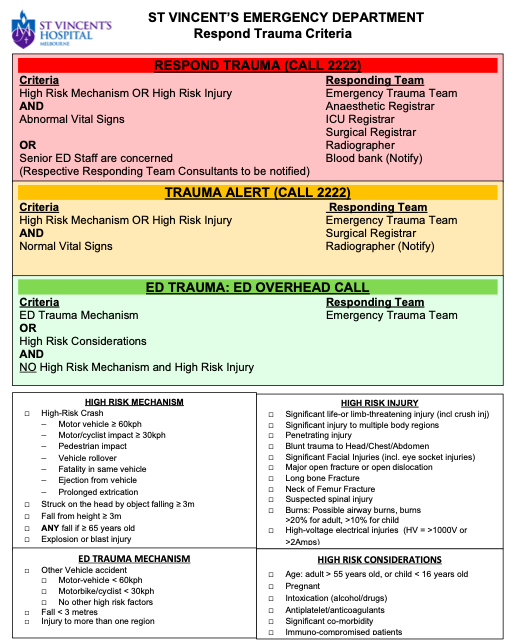
Respond Trauma
This chart illustrates the tiered respond trauma criteria and expected attendees - the ED team is led by the yellow consultant or registrar if available. Further information can be found on the intranet at
http://intranet/Policies/Clinical-Policies/Respond-Trauma.pdf
Code Brown
External Disaster resources, including the ED Notification and Escalation Plan, can be found on the intranet
SSDTA - Severe Substance Dependence Treatment Act
The SSDTA is a ‘last resort’ mandatory detention and treatment order issued by the Magistrates Court for select patients with severe substance dependence. Currently SVHM is the only declared treatment centre within the act
In the event of patients presenting to ED under the SSDTA, treatment must be provided and the patient should not be allowed to leave the department (similar to patients under a psychiatric treatment order)
Further information can be found in the SSDTA hospital policy below
How Do I…
-
• All requests must include a DECT phone contact number for communication of urgent results and queries
In Hours (M-F 0800-1700)
• Complete an online imaging request via the deLacy system, or fax a paper referral to 4305. Unless there is a particular concern, there is no need for a verbal discussion with the radiology registrar
After Hours (After 5pm and Weekends)
• All advanced imaging (CT, US and MRI) require approval by the radiology registrar (4311)
• Please discuss first with ED team leader to support your discussion
• Time of day should not impact the ability to perform a scan, however a sonographer will need to be called in for out of hours US scans
• Further information can be found in the ‘radiology agreement’ under the Admin/Policies tab of the ED intranet
-
• CT reports are dictated and are shown in PACS
• XRs may not get reported for several days, and ED may not receive results to check for many days
• You are encouraged to view and interpret all images you request!
-
• Fax a paper request to out-patient radiology, making a note on the request form outlining the urgency of the request
• Ensure the patient’s contact details are correct prior to sending the request - radiology will call or text the patient with an appointment time
• Ensure the patient is clear on whether they need to re-attend ED for the result or if they are to follow this up with a different provider eg GP
• It is good practice to provide the patient with contact details for the Radiology Department (4300) and suggest contacting them if they do not receive an appointment in a specific timeframe
-
• Ask the ED Clerks for assistance in arranging the vast majority out-patient referrals - you will be asked to estimate a requested timeframe
• Cardiology and Neurology referrals are online - linked on ED intranet ‘Clinical Resources’
• Some clinics (neurology first seizure, falls and balance) are privatised and require the patient to seek a GP referral to ‘activate’ the request
• A full list of referral pathways can be found under Clinical Resources on the ED intranet
• Booked or pending appointments can be seen in PAS on the ‘visits’ dropdown
-
New Private Referrals
• St Vincent’s Private Hospital (SVPH) offer a limited list of on call specialists. Contact the SVPH bed manager. If no specialist is available, the SVHM on-call specialist has the first right of refusal or may suggest someone you can call.
• If there is no capacity at SVPH you may contact Bed Brokers to assist finding a private specialist and bed
Pre-Existing Private Specialists
• Patients who attend ED and have a private specialist should be discussed with that specialist if possible
• The time of day may impact upon the timing of the conversation, although the urgency of the presentation may require a call at an unsociable hour
• Unrelated presentations may still require a courtesy call at an appropriate time, particularly if the patient requires an inpatient stay
• If the named private specialist is on leave, there will likely be a covering specialist - their rooms or call/paging service may be able to assist
-
• Additional forms will accompany patient notes for patient who have suffered injuries related to their employment (Workcover) or a transport accident (TAC)
• Accurate and timely completion of these forms have significant funding implications for the ED due to the separate revenue streams involved
• The forms consist of two sheets
1. A document detailing the patient’s injuries and their estimated time away from normal work duties. This should be given to the patient and used as a ‘work certificate’. The information provided will be used to guide funding for any required further interventions (eg operative management, physiotherapy)
2. A document with a ‘tick box’ summary of the amount of time spent with the patient, and the investigations and interventions performed in ED. This is kept with the patient notes/nursing chart and will be processed by ward clerk staff to facilitate funding of the patient’s treatment in ED from the relevant source
• Please ask you team leader for assistance in completing them in a timely manner